Ivanishvili's Georgia hits record 5.5 million tourist visits as two-year protest standoff continues
Tourism grew 8.4% in 2025 even as Georgian Dream faces sustained weekend marches and a suspended EU path.
By Lucas Mehta ·
Georgian Dream, the ruling party led by billionaire Bidzina Ivanishvili, presides over a country where economic growth and political division have moved in opposite directions. The party, in power since 2012, faces its longest continuous period of public unrest since taking office. This week marks the second anniversary of the contested parliamentary elections that triggered the current crisis.
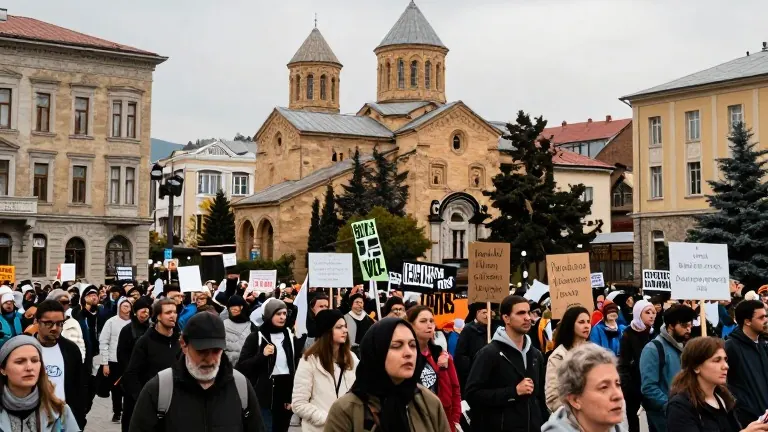
The political standoff began on October 26, 2024, following the disputed vote. Protests started two days later and reached a peak on November 28 of that year. At that time, the government announced it would not place the opening of EU accession negotiations on its agenda before the end of 2028. Georgia had been granted EU candidate status in 2023, making the suspension a major point of contention for the opposition.
Every weekend, thousands of demonstrators gather in Tbilisi’s Armenian quarter. The marches, known as the Saturday March, begin at Avlabari Square. Protesters walk toward the Bridge of Love, reach Freedom Square, and end at parliament. Their central demand is a reversal of Georgian Dream’s conservative policies and a return to a European trajectory. Critics accuse the government of growing authoritarianism and moving the country closer to Moscow.
Despite the political friction, international tourism reached a record high in 2025. The Georgian National Tourism Administration reported more than 5.5 million international visits. This figure represents an 8.4% increase over 2024. It is nearly ten times the number of visitors recorded two decades ago, when approximately 560,000 people traveled to the country.
Visitors come from Europe, the Middle East, and large numbers from Russia. Since Russia’s full-scale invasion of Ukraine in 2022, tens of thousands of Russian citizens have relocated to Georgia. They have opened businesses and injected capital into the economy. Their presence has also intensified pressure on the property market as they purchase homes across the country.
This influx has fueled local discontent. Many Georgians still view Russia as an occupying power, a sentiment rooted in the early 1990s wars in South Ossetia and Abkhazia and the August 2008 war. Russian military control over these regions, which account for roughly 20% of Georgian territory, remains a defining feature of the bilateral relationship.
The economic dependence on Moscow persists despite severed diplomatic ties. Trade, tourism, remittances, and energy imports from Russia continue to prop up the Georgian economy. GDP rose by 7.5% in 2025, marking five consecutive years of expansion. However, the government still struggles with unemployment, low wages, and depopulation in rural areas.
Relations with Brussels have deteriorated in recent months. The EU has criticized the Georgian government’s record on the rule of law and political repression. Many analysts believe that if Moscow strengthens its position in the Ukraine war, its ability to exert pressure on the Caucasus region will increase.
The country’s future is linked to these external geopolitical shifts. Georgia, with a population of fewer than 4 million, sits between Russia and Turkey. Its domestic support for the government is limited, and it remains internationally isolated on key issues.
The next major milestone is the upcoming parliamentary elections. The government plans to hold these votes in October 2028. Until then, the Saturday Marches are expected to continue, with protesters maintaining their pressure on the Georgian Dream leadership.
The tourism sector remains a key economic driver. The country offers historic sites, mountain villages, and a cosmopolitan capital. Tbilisi’s repurposed industrial spaces and underground scene draw visitors seeking a post-Soviet atmosphere. The port city of Batumi serves as a lively coastal hub, often compared to a Las Vegas of the Black Sea.
Ivanishvili, now in his 70s, made his fortune in Russia during the 1990s. He served as prime minister from 2012 to 2013. He founded Georgian Dream in 2012 and personally funded the renovation of the Rustaveli theatre, a symbol of national independence in Tbilisi.
Source: The Guardian