Russia and Iran Sign $25 Billion Deal for New Nuclear Plant as IAEA Access Shrinks
Moscow and Tehran are expanding their nuclear partnership to include a new facility in Hormozgan Province while the International Atomic Energy Agency struggles to verify Iran's nuclear activities.
By Elijah Davidson ·
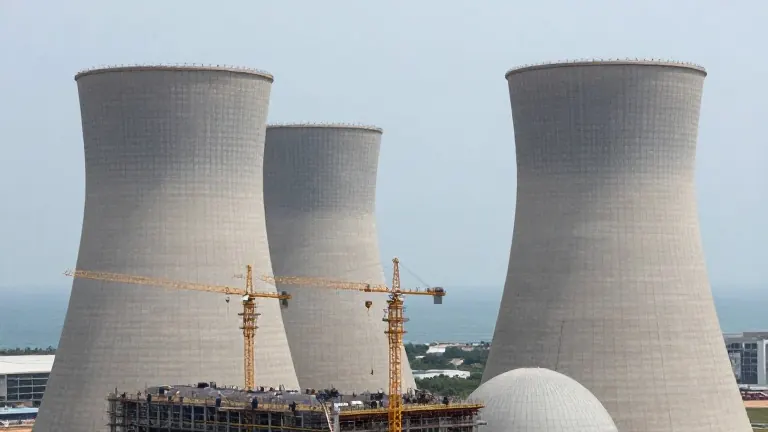
Russia and Iran are deepening their nuclear cooperation through the construction of new power plants and expanded fuel supplies as both nations contend with Western sanctions.
The partnership, which has historically centered on the Bushehr nuclear station on Iran’s southern coast, is now extending to new sites and broader technological exchanges.
Rosatom, Russia’s state nuclear corporation, continues its work at Bushehr despite recent military conflicts. Although the company evacuated most staff after the US-Iran war began in February, it reported on October 11 that 135 engineering and technical specialists had returned to the site.
Construction on two additional reactor units at Bushehr is ongoing. The second unit has passed 60 percent completion with a target start date of 2029, while work on a third unit has also begun.
In September 2025, the two countries signed an agreement to build a new nuclear power plant called Sirik in Iran’s Hormozgan Province, near the Strait of Hormuz. Iran’s state news agency IRNA stated the deal is worth $25 billion and will provide a combined capacity of approximately 5 gigawatts, exceeding the total capacity of the completed Bushehr complex.
The legal framework for this expansion is the Comprehensive Strategic Partnership Treaty, which entered into force in October 2025. Analyst Nikita Smagin of the Carnegie Endowment for International Peace noted in November 2025 that the balance of the relationship is shifting in Russia’s favor, citing Iran's urgent need for investment and limited alternative sources.
Researchers Dmitry Kovchegin and Arkady Mil-Man of Israel’s Institute for National Security Studies described Moscow’s approach as a calculated balancing strategy. They argued that Russia uses limited assistance to Iran to improve its negotiating position with the United States while avoiding a shift in the regional balance of power.
This expansion occurs against a backdrop of reduced international oversight. In a report published on June 4, the International Atomic Energy Agency stated it conducted inspections at Bushehr from June 1 to 3 but was unable to access other declared nuclear sites during that period.
The IAEA could not verify the status of nuclear material at four uranium enrichment facilities or confirm whether Iran suspended enrichment, reprocessing, and heavy-water activities as required by UN Security Council resolutions. The agency noted a significant gap in its ability to monitor these processes.
Nonproliferation specialists worry that civilian nuclear cooperation could facilitate the diversion of sensitive technologies. The US-based Arms Control Association stated in June 2025 that Iran’s accumulation of uranium enriched to 60 percent has no civil justification and allows for rapid production of weapons-grade material.
Source: RFE/RL