
Caltech study quantifies toxic metal exposure during 2025 LA fires
Researchers found that smoke from the Eaton Fire contained lead levels 80 times higher than background rates, exposing roughly 7 million people to elevated neurotoxins.
By Henry Castro ·
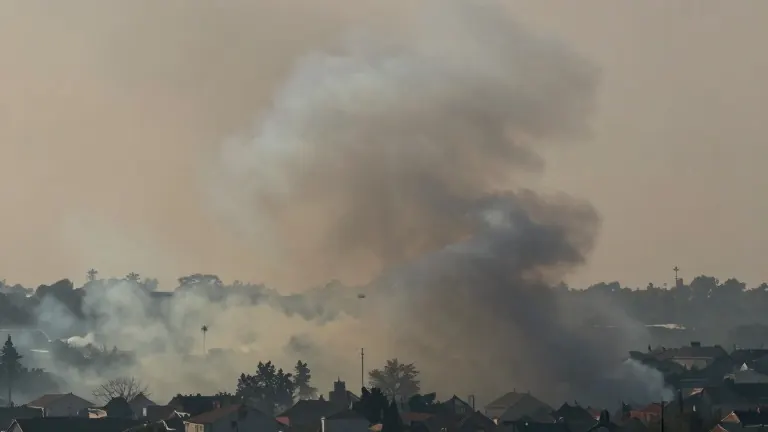
A team of researchers at the California Institute of Technology determined that smoke from the Eaton Fire in Los Angeles exposed millions of residents to toxic heavy metals at levels far exceeding normal background rates. The study, published in the journal Science Advances, analyzed the chemical makeup of the urban plume and found it contained significantly higher concentrations of lead, arsenic, and halogens compared to smoke from a typical wildfire.
The Eaton Fire and the Pacific Palisades fire ignited on January 7, 2025, killing at least 31 people and destroying more than 16,000 structures. As the flames consumed vehicles, building materials, and electronics, the smoke carried a complex mixture of chemicals that researchers tracked using the Atmospheric Science and Chemistry mEasurement NeTwork, or ASCENT. This network, which measures the size and chemical composition of fine particulate matter in real time, allowed scientists to monitor the plume's evolution hour by hour.
Nga Lee "Sally" Ng, an author of the study, explained that the new technology enabled the team to see the detailed components of the particles being inhaled. The data revealed that the urban smoke was fundamentally different from wildland fire smoke. When researchers compared the Eaton Fire plume to a 2024 wildfire in Riverside County that burned mostly vegetation, they found the LA fire emitted 50 times more lead, three times more arsenic, and seven times more halogens.
At the peak of the burning, approximately 7 million people in the Los Angeles area were exposed to lead levels 80 times higher than the typical background level over a 24-hour period. Lead is a neurotoxin linked to stunted development in children and higher blood pressure in adults, while arsenic is associated with various cancers. Although scientists understand the long-term effects of these metals, the specific health impacts of short-term, high-level exposure remain unclear.
Ed Avol, a professor emeritus at the Keck School of Medicine at the University of Southern California, noted that the hourly resolution of the data provided a clearer picture than standard weekly measurements. He described the findings as consistent with his expectations but surprising given the lack of prior documentation. Yaguang Wei, an assistant professor at the Icahn School of Medicine at Mount Sinai, said the results reinforce the idea that wildfire smoke is more toxic than other particulate sources, particularly when fires burn through residential areas filled with lead-based paint and plastics.
The research highlights the need for updated emergency response strategies as climate change drives larger, faster-moving fires into urban centers. Wei suggested that governments should invest in better monitoring, public alerts, and prescribed fires to mitigate risks. The study serves as a data point for policymakers considering how to protect public health in an environment where wildland and urban landscapes increasingly intersect.
Source: Sentinel Colorado